
Glass thermal insulation refers to specialized glass systems engineered to minimize heat transfer between indoor and outdoor environments. Unlike traditional single-pane glazing, insulated systems use advanced coatings, multiple panes, inert gas fillings, and structural enhancements to reduce conductive, convective, and radiant heat flow.
The goal is to improve the building’s thermal envelope by controlling:
By optimizing U-value, Solar Heat Gain Coefficient (SHGC), and Visible Light Transmittance (VLT), insulated glazing systems deliver measurable improvements in energy efficiency and indoor comfort.

Low-emissivity (Low-E) glass features a microscopically thin metallic coating that reflects infrared heat while allowing visible light to pass through.
There are two primary categories:
Low-E technology significantly enhances glass thermal insulation performance without compromising transparency.
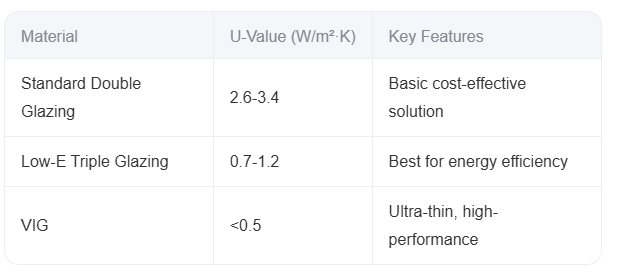
Multi-pane systems increase thermal resistance by adding additional air or gas cavities.
Double glazing: Standard energy-efficient solution
Triple glazing: Superior insulation for extreme climates
Triple-glazed systems are ideal for passive houses and high-performance commercial buildings requiring minimal heat loss.
Laminated glass integrates a PVB or SGP interlayer between panes. When combined with insulating cavities, it provides both thermal efficiency and enhanced safety.
Key benefits:
Improved impact resistance
Sound reduction
UV filtering
Enhanced security
This solution is widely used in airports, commercial complexes, and residential high-rises.
Vacuum insulated glass uses a vacuum layer between panes to eliminate air conduction and convection.
Performance highlights:
VIG represents next-generation glass thermal insulation technology for ultra-efficient buildings.
Glass thermal insulation systems are used across diverse building sectors:
These systems reduce HVAC loads and improve long-term energy savings.
Energy-efficient glazing reduces operational costs and enhances environmental certification potential (LEED, BREEAM).
Thermal performance combined with safety and acoustic control ensures comfort in high-traffic environments.
As a specialized architectural glass manufacturer, we ensure strict quality standards throughout production.
High-quality float glass is selected based on clarity, thickness, and structural performance.
Glass panels undergo controlled heating and rapid cooling to improve mechanical strength and safety performance.
Low-E coatings are applied using magnetron sputtering technology in a vacuum chamber. This ensures uniform thickness and long-term durability.
Precision aluminum or warm-edge spacers create sealed cavities. Argon gas filling improves thermal resistance while reducing convection.
High-performance sealants ensure airtight integrity, preventing moisture infiltration and maintaining long-term insulation performance.
Every batch undergoes strict testing for:
Our production lines are designed for large-scale export projects, supporting custom sizes, thicknesses, coatings, and performance specifications.
ISO 20492-1
EN 1279 for Europe
ASTM E2190 for North America
As a leading manufacturer specializing in high-performance architectural glass, we deliver innovative and cost-effective solutions for modern construction projects worldwide. Our core product portfolio includes:
Tempered Safety Glass (EN 12150-1 certified) [ Tempered Glass | Laminated Glass | Doors & Windows | Glass Floor ]
Energy-Efficient Low-E Glass (U-value ≤ 1.1 W/m²K) [ Low-e Glass | Insulating Glass ]
Single/Durable Coated Glass (Anti-reflective, self-cleaning options) [ Reflective Glass | Color Glass | Dichroic Glass ]
Custom Art Glass (Irregular shapes, patterns, and textures)